

Edge AI explained simply: it means running artificial intelligence closer to the user, on a phone, PC, wearable, robot, camera, car, or local server instead of relying only on a distant cloud data center. The goal is not to replace cloud AI completely. The goal is to put the right AI task in the right place.
That shift is why modern devices are getting NPUs, local small language models, smarter sensors, and more privacy-focused AI features. Phones, PCs, and wearables are becoming smarter because they can understand more context without waiting for every request to travel across the internet.
Edge AI explained for everyday devices
The cloud is still powerful, especially for large models and heavy reasoning. But cloud-only AI has limits. It can add latency, increase bandwidth cost, raise privacy concerns, and fail when connectivity is weak. Edge AI helps by handling practical tasks locally.
On a phone, that might mean live translation, image search, call screening, photo editing, or voice commands. On a PC, it can mean transcription, local document search, meeting summaries, and AI-assisted creative tools. On wearables, it can mean health signals, gesture detection, camera understanding, and always-available voice assistance.
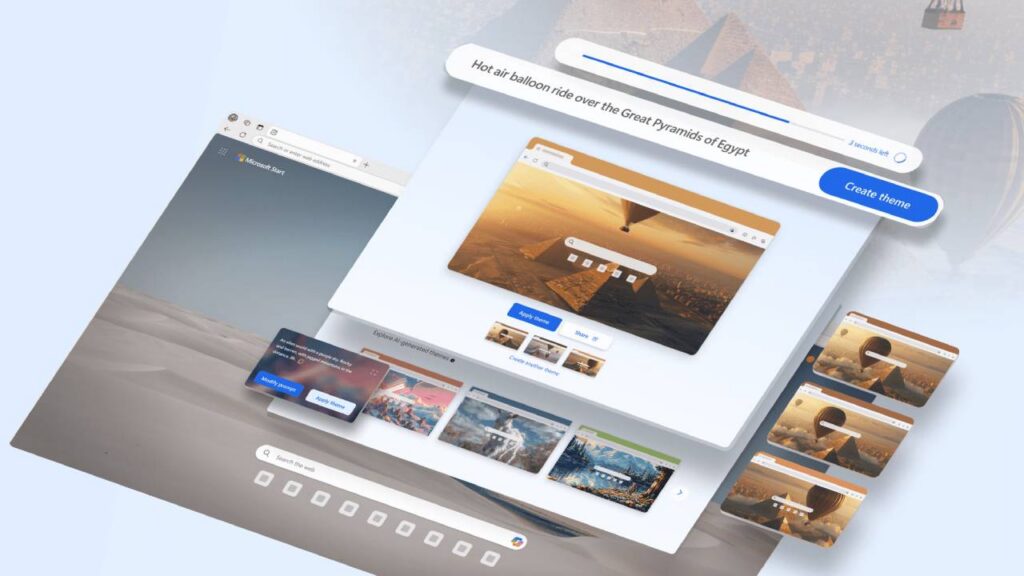
Microsoft Edge is a useful example because it is bringing AI into the browser itself. In a Microsoft Edge Blog post about on-device AI models and APIs, Microsoft described built-in models, language detection, translation APIs, and local speech recognition that can run without relying on specialized hardware or cloud services.
Why NPUs matter
The hardware change behind edge AI is the neural processing unit, or NPU. A CPU is flexible, a GPU is strong for parallel workloads, and an NPU is optimized for certain machine-learning tasks at lower power.
This matters because AI features are often continuous. A wearable may listen for a wake word. A laptop may blur background video. A phone may identify objects through the camera. Running those workloads on the wrong chip can drain battery and create heat.
Intel’s recent edge AI robotics work shows the same pattern. In its article on Core Ultra Series 3 for edge AI robotics, Intel described robots moving away from bulky discrete GPUs toward integrated CPU, GPU, and NPU architectures for local inference.
Privacy and speed are the main benefits
The most obvious benefit is speed. If a model runs locally, a device can respond instantly instead of waiting later. That is useful for real-time translation, camera understanding, robotics, accessibility, and health tracking.

The second benefit is privacy. Personal data can stay on the device for more often. A local model can summarize a file, categorize a photo, or transcribe a short voice note without sending the raw content to a cloud server.
The third benefit is cost. Cloud inference is not free. If billions of devices can handle smaller AI tasks locally, companies can reserve cloud models for heavier reasoning and reduce routine server load.
The limitations
Edge AI is not magic. Local models are usually smaller than frontier cloud models. They may be less capable at complex reasoning, long context, and open-ended research. Device storage, battery, memory, and thermal limits also constrain what can run locally.
That is why the likely future is hybrid AI. Simple or sensitive tasks run on the device. Harder tasks go to the cloud. The best user experience will hide that complexity while still giving users meaningful privacy controls.
Why it matters in 2026
Edge AI is becoming a product requirement, not a niche feature. Buyers will start asking whether a laptop has a strong NPU, whether a phone can run personal AI privately, and whether a wearable can understand context without constant cloud dependence.
For developers, edge AI changes app design. They will need to decide which features run locally, which need cloud reasoning, how to handle fallback, and how to explain privacy clearly.
For users, the impact should be simple: faster responses, more useful devices, and fewer moments when AI feels disconnected from what is happening in the real world.
There is also a reliability benefit. A device that can handle core AI tasks locally can keep working when a network is slow, expensive, or unavailable. That matters for travelers, field workers, healthcare devices, industrial robots, cars, and classrooms. The more AI moves into real-world environments, the more important offline and low-latency operation becomes.
Edge AI also changes the business model. Instead of paying for every small cloud request, companies can ship more intelligence in the device and use the cloud only when the task needs larger models or fresh web data. That can make AI features cheaper to run and easier to scale.
The result is a quieter but important shift in device value. The smartest device will not always be the one with the largest model. It will be the one that can choose local and cloud intelligence correctly.
You can follow more developments in Technowatt’s Artificial Intelligence coverage.