

Wi-Fi 8 explained simply: it is the next major Wi-Fi generation, but its biggest promise is not a higher headline speed. Wi-Fi 7 already pushed peak throughput very far with 320 MHz channels, 4K QAM, Multi-Link Operation, and the 6 GHz band. Wi-Fi 8 is expected to focus on making wireless connections more reliable in the real world.
That makes the upgrade less flashy but potentially more useful. Most people do not complain because their router’s theoretical maximum speed is too low. They complain because video calls freeze, gaming latency jumps, smart home devices drop offline, and performance collapses when they move to another room.
Wi-Fi 8 explained through Ultra High Reliability
Wi-Fi 8 is based on IEEE 802.11bn, an initiative widely described as Ultra High Reliability, or UHR. Qualcomm’s Wi-Fi 8 overview says the standard is being designed for stable performance across dense networks, edge-of-coverage situations, and devices that are moving between access points.
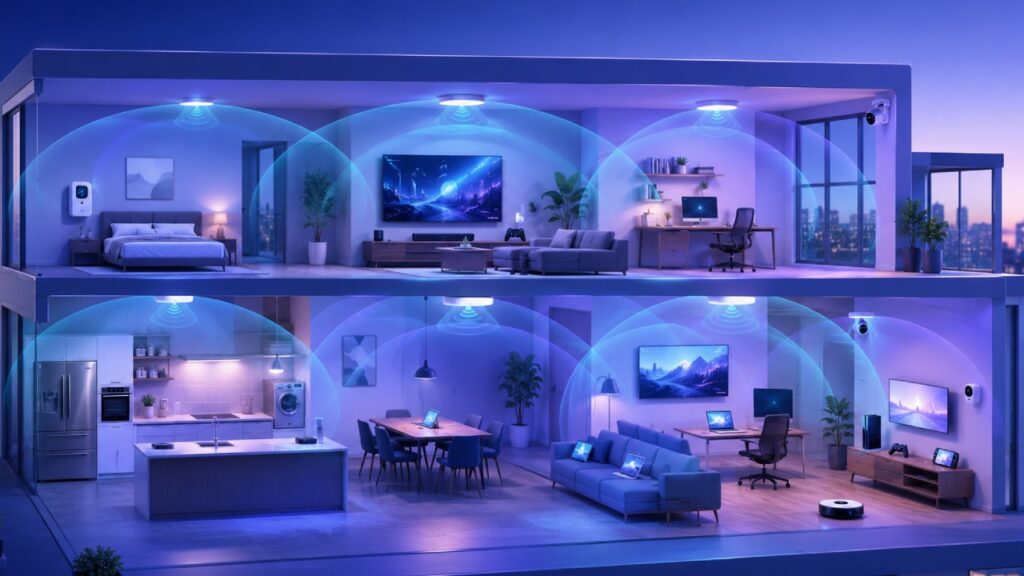
That framing is important. Wi-Fi 8 is not abandoning speed, but it is shifting the priority from best-case lab numbers to worst-case user experience. A slightly lower peak speed with fewer drops, lower jitter, and smoother roaming can feel better than a faster connection that behaves unpredictably.
Qualcomm has also said IEEE 802.11bn is expected to be finalized in 2028, which means early hardware can appear before the standard is fully complete, but mainstream adoption will take time. That is normal for Wi-Fi transitions.
The technical side: 802.11bn, bands and reliability tools
Wi-Fi 8 keeps much of the Wi-Fi 7 foundation instead of chasing a completely new speed headline. The expected base still includes 2.4 GHz, 5 GHz and 6 GHz operation, up to 320 MHz channels, 4096-QAM, MU-MIMO, OFDMA and multi-link ideas from the Wi-Fi 7 era. The difference is how the network behaves when conditions are imperfect.
The new technical work is aimed at reliability. Qualcomm highlights Enhanced Long Range for edge-of-coverage devices, improved LDPC coding for better error correction, Unequal Modulation for degraded or asymmetric signal conditions, Intermediate Modulation and Coding Schemes for smoother performance steps, Distributed Resource Units for range extension on low-power clients, and better in-device coexistence between Wi-Fi, Bluetooth and UWB.
Those details matter because real networks are messy. A doorbell camera at the edge of the house, a laptop moving between mesh nodes, a headset sharing antennas with Bluetooth, and a phone in a crowded apartment building all create conditions where peak speed is not the main issue.
Why speed is no longer the only problem
Home and office networks are more crowded than ever. A single home may have phones, laptops, tablets, TVs, consoles, cameras, speakers, appliances, watches, and smart home hubs competing for airtime. Apartment buildings and offices add overlapping networks from neighbors and nearby rooms.
Speed tests hide many of these problems. A device can show a high download number and still suffer from latency spikes or packet loss. That matters for cloud gaming, video meetings, AR glasses, wireless VR, industrial devices, and AI-powered edge systems that need consistent responsiveness.
Wi-Fi 8 aims to make the network more predictable under pressure. That means better coordination between access points, better performance near the edge of coverage, better handling of interference, and smoother movement between mesh nodes.
The improvements users may actually notice
Users do not need to memorize every standard feature. The practical goal is easier to understand: keep the connection stable when signal quality is imperfect. That includes devices at the edge of a home network, cameras outside the house, laptops moving between rooms, and phones switching between access points.
Roaming is a major piece. Mesh routers are common, but moving from one node to another can still cause glitches. Wi-Fi 8 is expected to improve how devices transition across a network so calls, streams, and real-time apps do not stumble.
In-device coexistence is another overlooked issue. Modern phones and laptops often run Wi-Fi, Bluetooth and sometimes UWB at the same time. Better coordination can reduce drops, delays and interference when several radios share limited space inside one device.
Who will benefit first?
Enterprises, stadiums, campuses, factories, hospitals, and large venues may benefit early because they deal with dense networks and mission-critical devices. A warehouse scanner, hospital device, security camera, or industrial sensor does not only need bandwidth. It needs dependable connectivity.
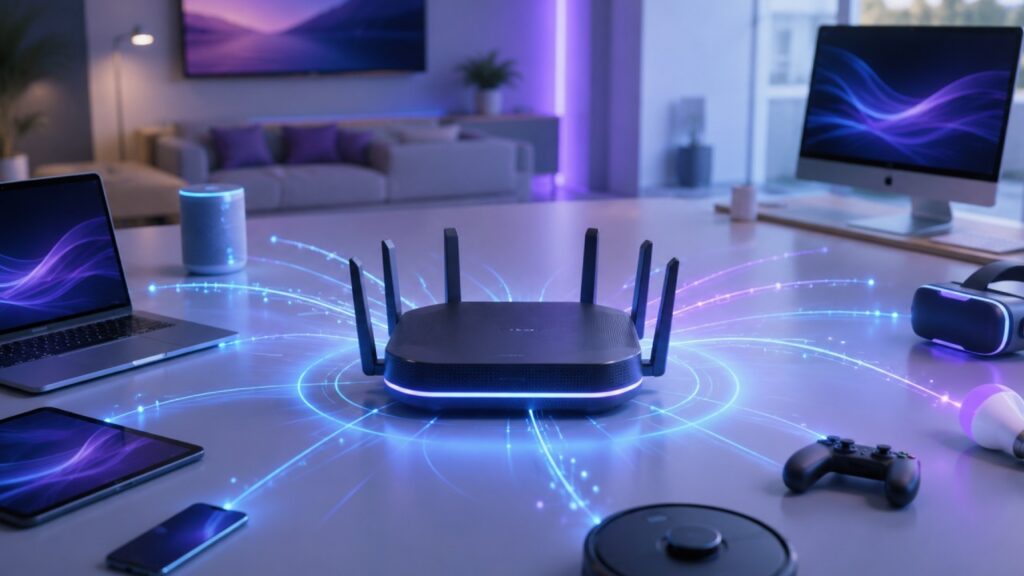
Homes will benefit too, especially larger homes with mesh systems, crowded apartments, and households with many smart devices. Wi-Fi 8 could make everyday wireless feel less fragile even if internet service speed stays the same.
Gamers and remote workers are another clear audience. For them, stable latency is often more important than another peak-speed upgrade. A video call that never drops is more valuable than a router box advertising an enormous theoretical number.
Should you wait for Wi-Fi 8?
Most users should not wait if they need a router today. Wi-Fi 7 is already fast and capable, and Wi-Fi 8 products will take time to mature. Early devices may also be expensive, and the full benefits will require both routers and client devices that support the new standard.
If your current network is unreliable, the better short-term fix may be router placement, wired backhaul for mesh, fewer overloaded channels, or an upgrade to Wi-Fi 6E or Wi-Fi 7. Wi-Fi 8 is worth watching, but it is not a reason to delay every purchase.
The bigger shift
The key message is that Wi-Fi is maturing. Peak speed still matters, but modern wireless needs to support real-time apps, AI devices, wearables, AR, IoT, and dense environments where reliability is the differentiator.
That is why the next Wi-Fi upgrade is not mainly about speed. It is about making the speed you already have more usable, more consistent, and less dependent on perfect conditions.
Wi-Fi 8 may not look dramatic in a simple spec table. If it works as intended, users will notice something better: fewer interruptions.
You can follow more developments in Technowatt’s Computing coverage.