

Solid state batteries consumer electronics interest is rising because phones, laptops, wearables, earbuds, trackers, and rings all need more battery life without getting larger or less safe. The promise is attractive: replace liquid electrolytes with solid materials, improve safety, raise energy density, and potentially enable faster charging.
The reality is more cautious. Solid-state batteries are already relevant for small devices, but laptops and smartphones are harder targets. The technology has to scale in size, survive daily charging, handle heat, remain thin, and be manufactured at consumer-electronics volumes.
Solid state batteries consumer electronics explained
A conventional lithium-ion battery uses a liquid or gel electrolyte to move ions between electrodes. A solid-state battery uses a solid electrolyte instead. That can reduce leakage and flammability risks and may allow higher energy density, depending on the chemistry.
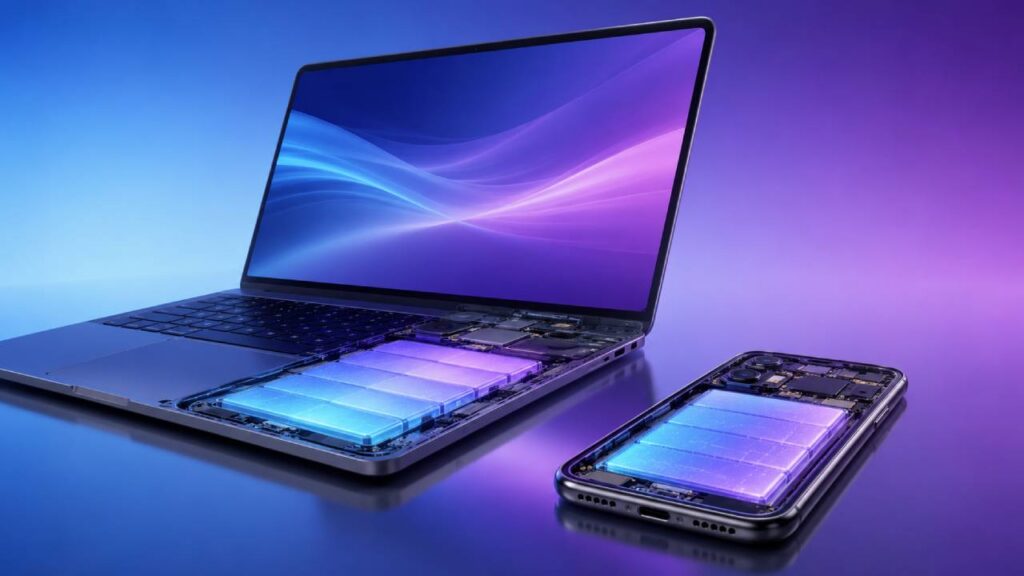
The important detail is that “solid-state” is not one single battery. Materials vary. Some designs use oxide-based solid electrolytes. Others use sulfide-based systems or polymer approaches. A coin-cell replacement for a wearable is a very different engineering problem from a large smartphone pouch cell or laptop battery pack.
TDK’s 2024 announcement is a good example. The company said it developed a material for its CeraCharge solid-state battery with an energy density of 1,000 Wh/L, about 100 times greater than TDK’s conventional solid-state battery. TDK said the technology is aimed at wearable devices such as wireless earphones, hearing aids, and smartwatches, with the goal of replacing coin cell batteries.
The technical side: density, safety and scale
TDK’s solid-state battery announcement highlights oxide-based solid electrolyte and lithium alloy anodes. The oxide-based electrolyte is important because TDK frames it as extremely safe and suitable for devices that touch the human body.
That safety angle matters for wearables. Earbuds, hearing aids, smart rings, and watches sit close to skin and often use very small batteries. A safer rechargeable cell that can replace disposable coin cells could improve design flexibility and reduce waste.
But smartphones and laptops need much larger cells. Larger batteries face mechanical stress, swelling, cycle-life demands, fast-charging heat, and packaging constraints. A material that works well in a tiny cell does not automatically scale to a phone battery.
Why wearables may come first
Wearables are the logical first market because their batteries are small and their energy needs are lower. A smartwatch, medical wearable, hearing aid, or tracker can benefit from a compact, safe cell without requiring the same capacity as a phone or laptop.
There is also a regulatory push. TDK notes that replacing coin cell primary batteries could help meet EU battery regulations that encourage rechargeable alternatives. That gives companies a practical reason to improve small rechargeable batteries even before phones are ready.
For consumers, the first benefits may look modest but useful: smaller wearables, longer battery life, rechargeable accessories, and fewer disposable coin cells.
Are smartphones next?
Smartphones are possible, but not imminent. A phone battery has to support high current draw from displays, cameras, modems, AI chips, gaming, and fast charging. It also has to stay safe across years of drops, heat, pressure, swelling, and thousands of charge cycles.
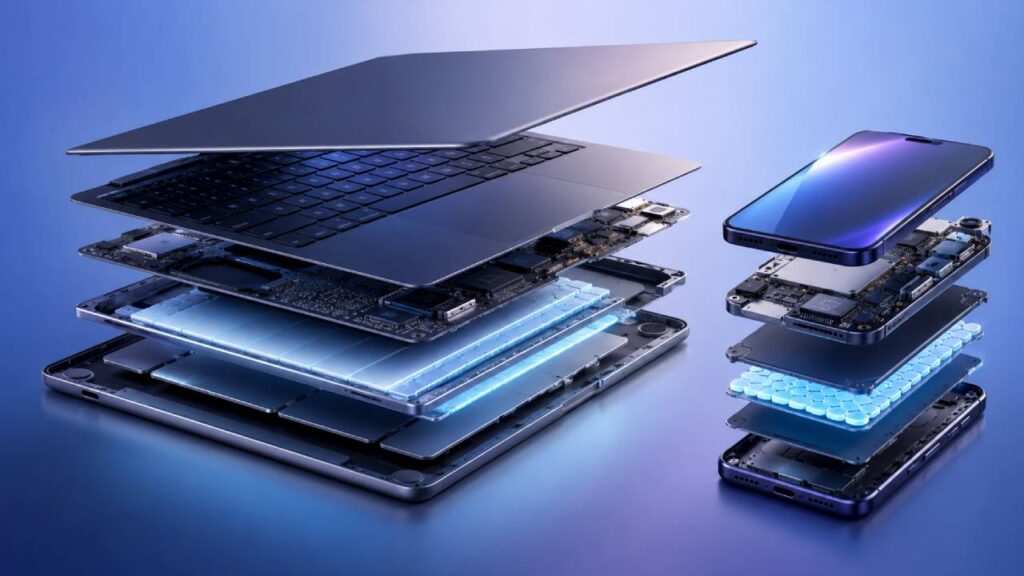
The challenge is not only energy density. Manufacturing yield, cost, cell flexibility, durability, and supply-chain readiness all matter. A phone maker cannot risk a battery chemistry that performs well in the lab but fails under real-world abuse.
That is why solid-state batteries may enter phone-adjacent products first: smart rings, earbuds, tags, styluses, medical wearables, and accessories. Smartphones may follow only after suppliers prove larger formats can meet safety and cycle-life expectations.
What about laptops?
Laptops are also a difficult target. A laptop pack is larger than a phone battery and must power high-performance CPUs, GPUs, displays, SSDs, radios, and cooling systems. It also needs predictable behavior under travel, charging docks, sleep states, and high-load workloads.
Solid-state batteries could eventually help thin laptops gain more runtime or reduce fire risk, but cost and scale will be decisive. Laptop makers already use mature lithium-ion and lithium-polymer supply chains. A new chemistry must offer enough advantage to justify redesigning packs, charging systems, certification, and repair procedures.
For now, the more realistic path is gradual. Small devices first, then niche premium electronics, then larger consumer devices if production and durability improve.
What to watch next
Watch three signals. First, sample-to-production progress: announcements matter less than shipping cells. Second, form factor: coin cells, thin-film cells, pouch cells, and battery packs each tell a different story. Third, cycle life and charging data: energy density is only useful if the battery survives daily use.
The short answer is that solid-state batteries are coming to consumer electronics, but not evenly. Wearables are the near-term target. Smartphones and laptops are the bigger prize, but they need larger, tougher, cheaper cells before the shift becomes mainstream.
Solid state batteries consumer electronics hype is justified only if it stays grounded in those constraints. The technology is promising, but the next breakthrough users actually feel may arrive in small devices before it reaches the phone in their pocket.
You can follow more developments in Technowatt’s Computing coverage.